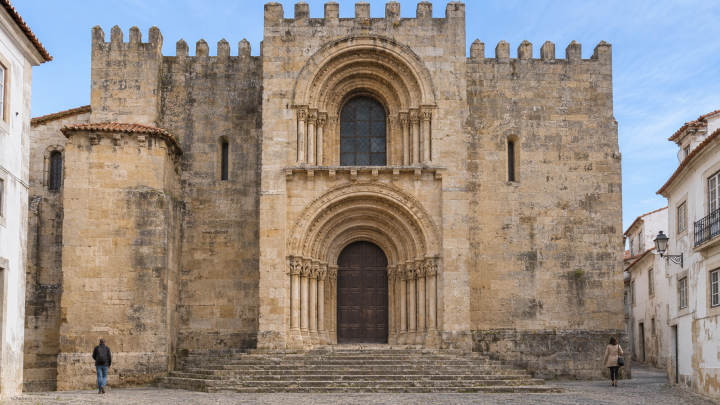
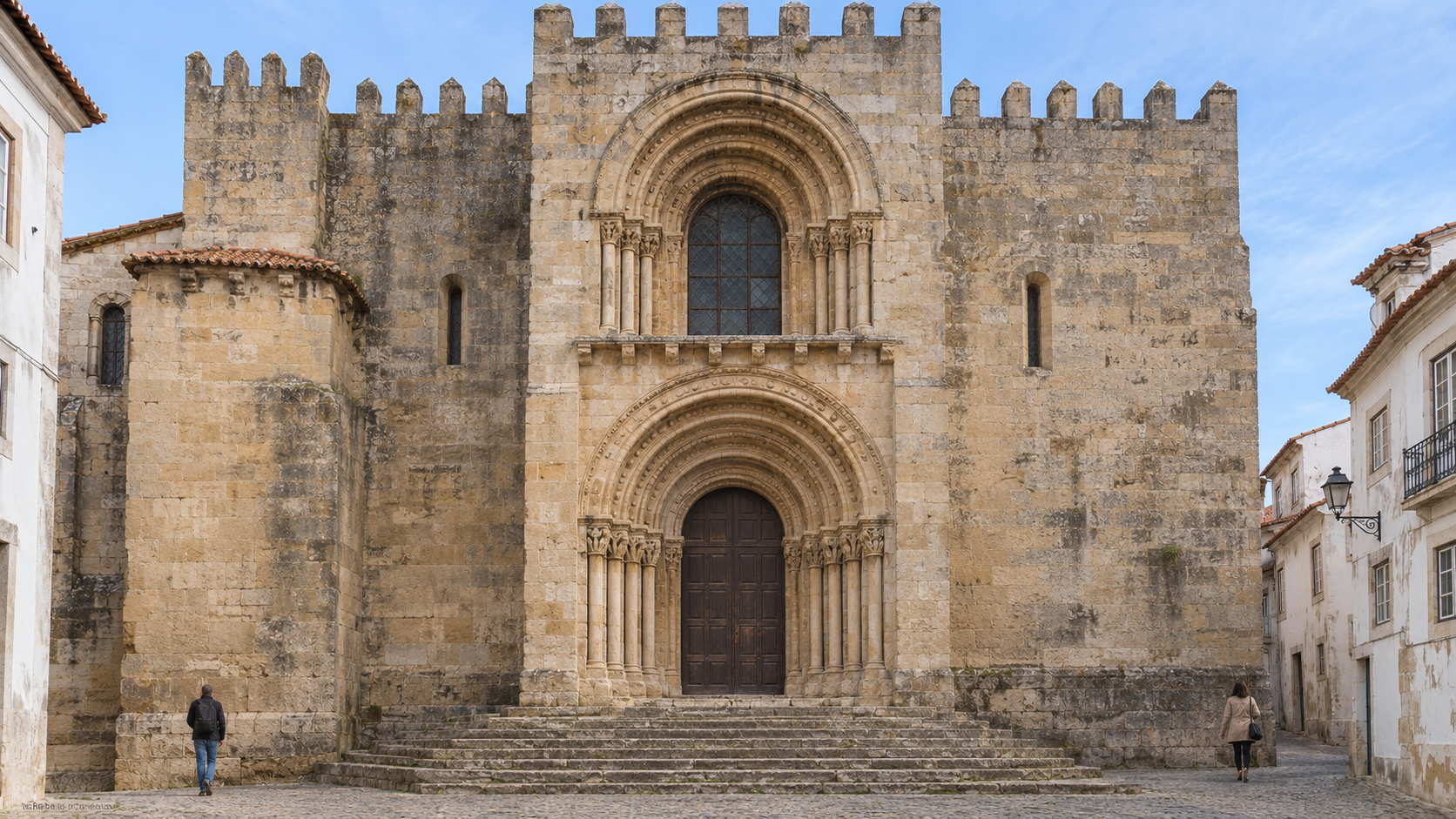
Old Cathedral of Coimbra / Sé Velha de Coimbra (Coimbra, Portugal)
Cultural Heritage Destination COUNTRIES AND TERRITORIES Portugal Visitor Attractions, Culture and Heritage
Coimbra, Portugal
-
2026

A consecration stone dated 1117 records an earlier church on the site. The main building campaign for the present cathedral was under way by the early 1160s, when Bishop Miguel Salomão and King Afonso Henriques supported the construction of a new episcopal church in Coimbra. Its design is attributed to Master Roberto, a French architect who also worked on Lisbon Cathedral. Master Bernardo supervised construction locally and was succeeded by Master Soeiro. The cathedral was consecrated in 1184, while work was still in progress. In 1185, Sancho I, Portugal’s second king, was crowned there.
Built of yellow limestone on a hillside in the upper town, the cathedral retains much of its Romanesque form. Narrow windows, projecting buttresses, and battlements give the exterior the appearance of a fortress. On the west front, a deeply recessed doorway and the arched window above it carry geometric and plant ornament. Inside, a barrel vault covers the central nave, while galleries run above the two side aisles. Many of the column capitals are carved with foliage and animals. The Gothic cloister, begun around 1218 on the south side, shows how the builders adapted the complex to the hillside: its square courtyard sits at a slight angle to the church, and paired pointed arches line its walks.
Two later commissions changed what worshippers saw at the altar and on entering from the north. In 1498, Bishop Jorge de Almeida commissioned the Flemish sculptors Olivier de Gand and Jean d’Ypres to make the high altarpiece. Its painted and gilded woodcarving is in the late Gothic style. The north portal, known as the Porta Especiosa, dates from the 1530s. Associated with João de Ruão and Nicolau de Chanterene, it takes the form of a three-tiered Renaissance triumphal arch, with a relief of the Virgin and Child above the entrance.
In 1772, after the expulsion of the Jesuits, the cathedral chapter moved to the former church of the College of Jesus, now known as the Sé Nova. The baptismal font and choir stalls went with it. The old cathedral became the seat of the parish of São Cristóvão in 1816 and remains an active place of worship. Later restorations altered parts of the interior: in 1894, for example, the carved Mudéjar wooden ceiling over the choir was dismantled. It is now preserved in Coimbra’s Machado de Castro National Museum. Portugal designated the church a National Monument in 1907 and confirmed the classification in 1910.
The cathedral lies within the Alta component of the University of Coimbra – Alta and Sofia, inscribed on the UNESCO World Heritage List in 2013. Visitors can explore the church and cloister, while the square outside has a distinct place in the city’s musical life. At the Serenata Monumental, which traditionally opens the Queima das Fitas student festival, the crowd falls silent at midnight as student musicians perform Canção de Coimbra, the city’s fado tradition, from the cathedral steps.
References
Alarcão, J. (2008). Coimbra: Cidade universitária e monumental. Imprensa da Universidade de Coimbra; Botelho, M. L. (2010). A Sé Velha de Coimbra e a arquitetura românica portuguesa. Faculdade de Letras da Universidade do Porto; Craveiro, M. L. (2011). A Sé Velha de Coimbra. Direcção Regional de Cultura do Centro; Markl, D. (1986). O retábulo da Sé Velha de Coimbra. Imprensa Nacional-Casa da Moeda;
See Also
Map