Ruins of Conimbriga / Ruínas de Conímbriga (Condeixa-a-Nova, Coimbra District, Portugal)
Archaeological Conservation and Heritage Management Cultural Heritage Destination COUNTRIES AND TERRITORIES Portugal Visitor Attractions, Culture and Heritage
Condeixa-a-Nova, Coimbra, Portugal
-
2026

Conimbriga stands on a naturally sheltered plateau near the village of Condeixa-a-Velha in central Portugal. People settled here in the Late Bronze Age, and a fortified settlement occupied the plateau during the Iron Age. Under Roman rule, Conimbriga became an administrative and commercial centre in the province of Lusitania. A road through the city linked Olisipo (Lisbon) with Bracara Augusta (Braga).
The first major Roman building programme began under Emperor Augustus in the late first century BCE. It included a forum, public baths and an aqueduct that carried water from a spring at Alcabideque, about three kilometres away. Most of the aqueduct ran underground. At the city, a distribution tank fed a network of pipes and channels that supplied fountains, bathhouses and private residences by gravity. Under Emperor Vespasian (69–79 CE), Conimbriga gained municipal status. Its inhabitants rebuilt the forum around a colonnaded square dominated by a temple dedicated to the imperial cult.
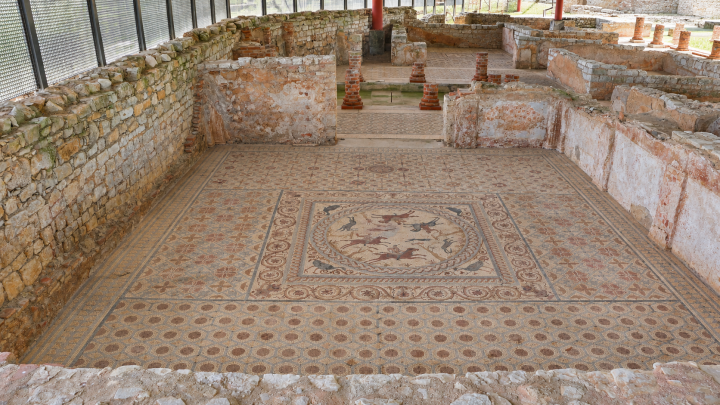
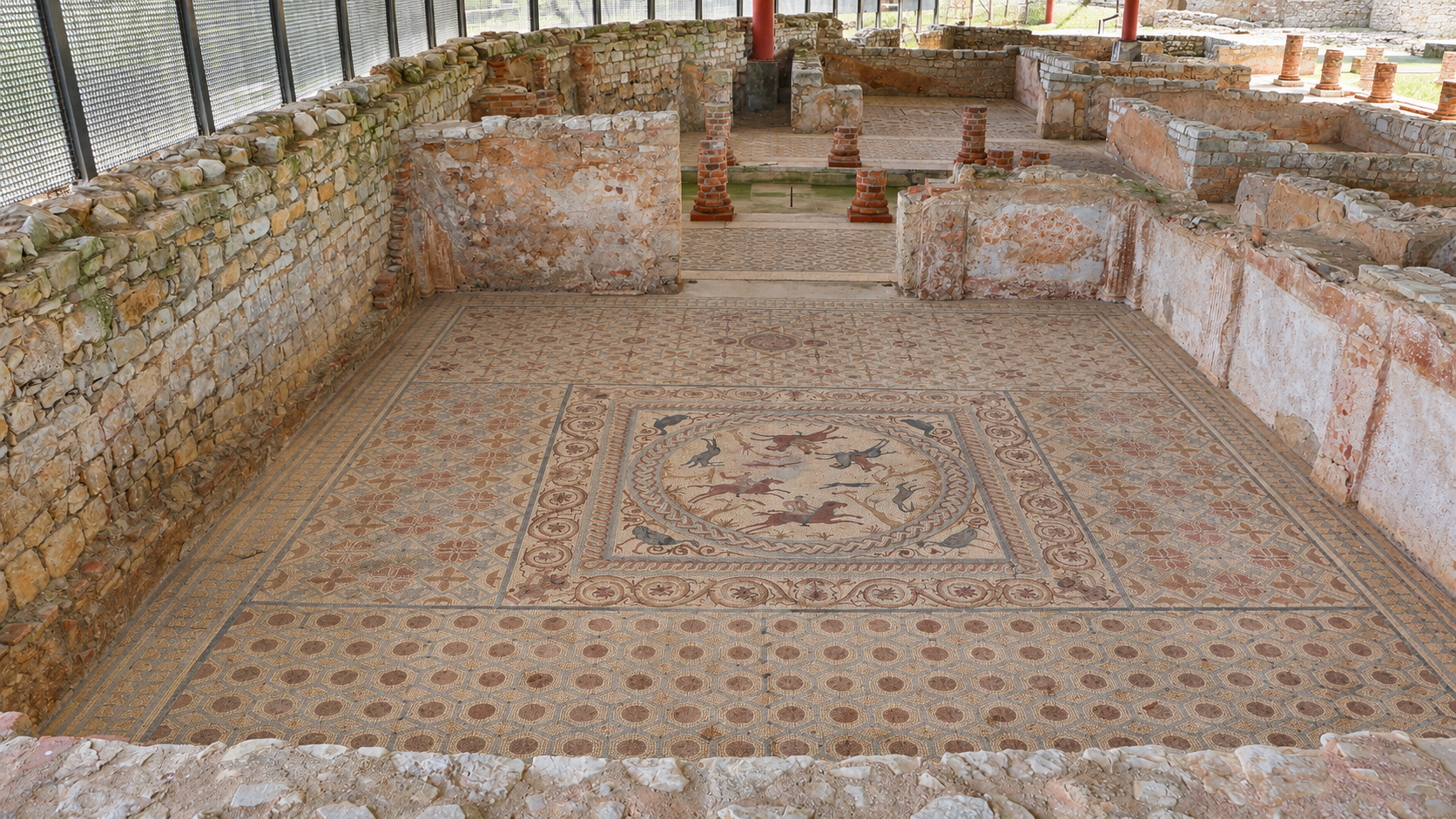
The House of the Fountains (Casa dos Repuxos) shows how residents used the public water supply in the design of a private home. Water jets animated its central courtyard, and the dining room overlooked a U-shaped pool. In an adjoining room, the floor mosaic depicts a hunt; traces of painted plaster survive on the walls. The largest residence excavated at the site, conventionally called the House of Cantaber, occupied about 3,260 square metres. Cantaber was a local aristocrat known from a fifth-century account, but the identification of the house as his remains uncertain.
In the late third or early fourth century CE, a new defensive wall enclosed little more than half of the earlier urban area of approximately 22 hectares. Its builders dismantled houses and public buildings along its route, reusing carved stone and inscriptions in the masonry. The Suebi attacked Conimbriga in 465 and 468, but people continued to live within the walls. At the House of Cantaber, for example, later occupants divided courtyards and adapted former living quarters for craft work. Regional authority gradually shifted to nearby Aeminium, present-day Coimbra, while settlement at Conimbriga continued into at least the 12th century.
The Instituto de Coimbra undertook exploratory excavations in 1873 and more extensive work in 1899. Portugal classified the ruins as a National Monument in 1910. Systematic excavation began in 1929 under Vergílio Correia, followed by campaigns to conserve the exposed masonry and mosaics. The site museum opened in 1962. Research continues: in 2026, the removal of traffic from a municipal road that crossed the House of the Fountains allowed archaeologists to investigate a previously inaccessible part of the residence.
Today, the National Museum of Conímbriga brings together the ruins and the objects recovered from them. The outdoor route covers about three hectares, allowing visitors to trace the aqueduct, walk between the forum and baths, and see the mosaics in the rooms for which they were made. The museum’s collection of pottery, coins, inscriptions and household objects complements the buildings with evidence of trade, work and domestic life in Roman Lusitania.
References
Alarcão, J. (1994). Conimbriga: O chão avermelhado de sangue. Livraria Almedina; Alarcão, J., & Étienne, R. (Eds.). (1974–1979). Fouilles de Conimbriga (Vols. 1–7). Mission archéologique française au Portugal; Musée monographique de Conimbriga; Correia, V. H. (2003). Conímbriga: Guia das ruínas. Instituto Português de Museus; Edições ASA; Correia, V. H. (2013). A arquitectura doméstica de Conimbriga e as estruturas económicas e sociais da cidade romana. Centro de Estudos Arqueológicos das Universidades de Coimbra e Porto; Direcção-Geral do Património Cultural; Liga de Amigos de Conimbriga; Correia, V. H. (2024). Conimbriga: A vida de uma cidade da Lusitânia. Imprensa da Universidade de Coimbra. https://doi.org/10.14195/978-989-26-2484-6; De Man, A. (2006). Conimbriga: Do Baixo Império à Idade Média. Edições Sílabo; Direção-Geral do Património Cultural. (t.y.). Ruínas de Conímbriga: Síntese histórica e patrimonial [Dossier de Monumento Nacional]. Patrimonios.pt. https://patrimonios.pt/en/ruinas-romanas-de-conimbriga/; Turismo de Portugal. (t.y.). Ruínas de Conímbriga. VisitPortugal. https://www.visitportugal.com/pt-pt/content/ruinas-conimbriga
See Also
Map