Historic Center of Guarda (Guarda, Portugal)
Cultural Heritage Destination COUNTRIES AND TERRITORIES Portugal Visitor Attractions, Culture and Heritage
Guarda, Portugal
-
2026

Guarda’s historic centre developed around the royal foundation formalised by King Sancho I’s charter of 27 November 1199. Situated on the northeastern margins of Serra da Estrela, the city strengthened royal authority and the defence of Portugal’s eastern frontier. Its early development combined military, administrative, commercial and ecclesiastical functions, including the transfer of the episcopal seat from Egitânia, present-day Idanha-a-Velha. Guarda is recognised as mainland Portugal’s highest city, with its castle hill reaching approximately 1,056 metres above sea level.
The medieval defensive system developed through successive building campaigns, including alterations during the reigns of Denis, Ferdinand I and John I. Surviving elements include the Torre de Menagem, Torre Velha, Torre dos Ferreiros, Porta da Erva and Porta d’El Rei. These structures reflect different stages of military construction and adaptation to the hilltop terrain. The walls no longer form a complete enclosure: substantial sections disappeared during nineteenth- and early twentieth-century urban expansion, sometimes supplying stone for other buildings. The surviving towers and gateways nevertheless retain an important role in the historic townscape.
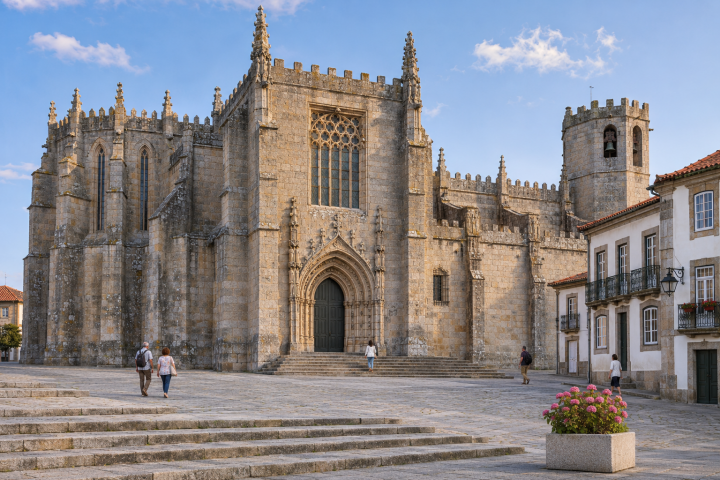
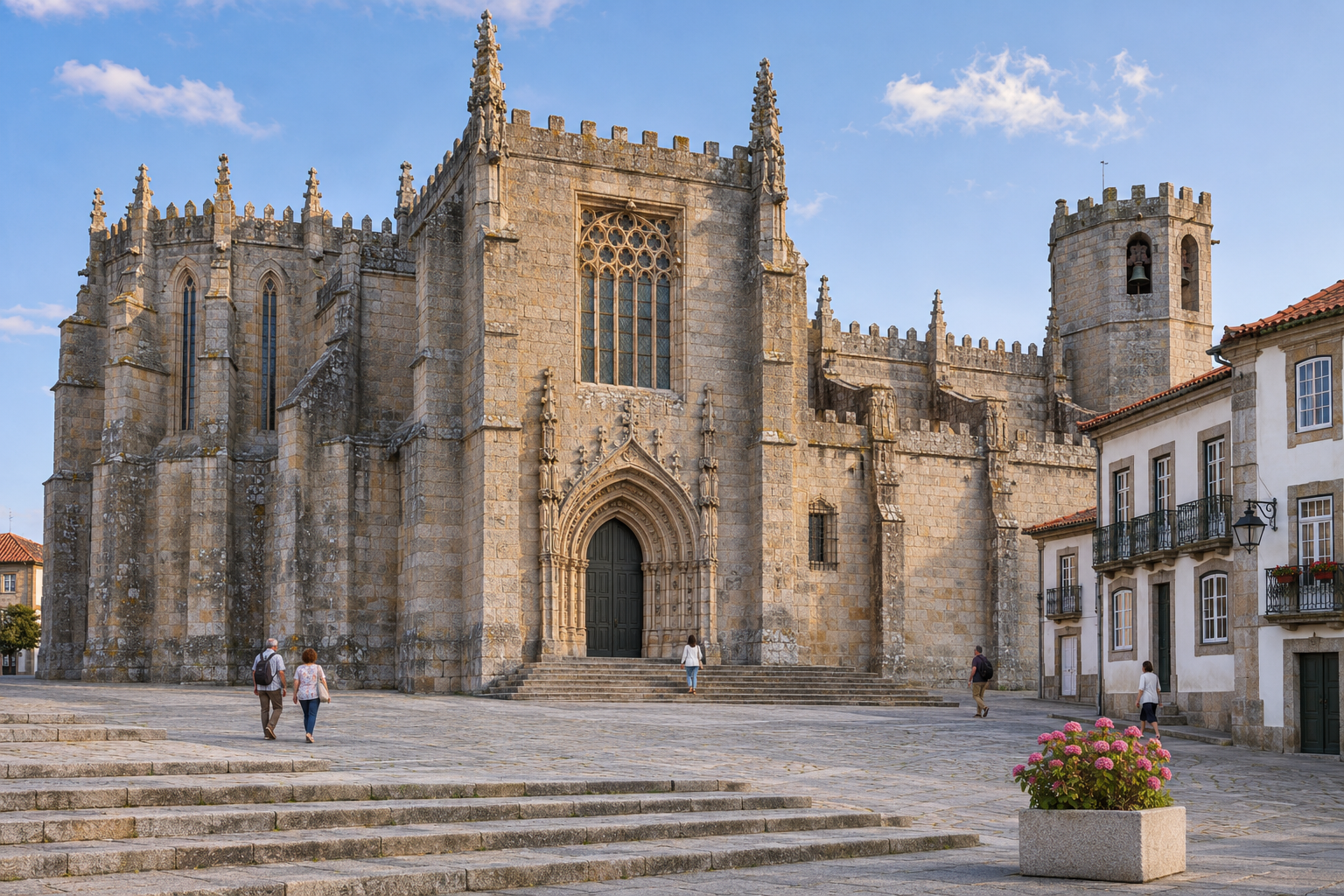
The principal architectural landmark is the Cathedral of Guarda, overlooking Praça Luís de Camões. Construction of the present building began around 1390 and continued into the sixteenth century. Its monumental granite exterior, reinforced towers, buttresses, pinnacles and gargoyles combine a fortress-like appearance with Gothic and Manueline forms. The western façade has a Manueline portal, while the frequently used northern entrance opens towards the square through a Gothic portal beneath a Manueline window. Inside, three aisles, ribbed vaults and a substantial transept define the spatial arrangement. The main altarpiece, carved in Ançã limestone during the sixteenth century, is associated with João de Ruão and his workshop.
The surrounding streets preserve a varied architectural record extending beyond the Middle Ages. Rua Francisco de Passos, traditionally known as Rua Direita, was an important commercial artery and retains decorated windows and façades from successive periods. Around Praça Luís de Camões stand the Renaissance former town hall and the eighteenth-century Solar dos Póvoas. The churches of São Vicente and Misericórdia contribute Baroque architecture to the historic centre. The former episcopal palace and seminary complex accommodates museum collections, linking the city’s ecclesiastical history with its present cultural functions.
The former Jewish quarter occupies streets near São Vicente and Porta d’El Rei, within the medieval enclosure. Documentary evidence establishes a Jewish presence by the late thirteenth century, with records concerning property, commercial activities and a synagogue. The community contributed to urban life through trade, crafts and professional services. The expulsion decree of 1496 and subsequent conversions profoundly altered this history. Today, the neighbourhood forms part of Jewish heritage interpretation, although individual buildings and carved symbols require careful assessment before being identified as specifically Jewish remains.
Conservation has substantially shaped the surviving monuments. Major cathedral restoration began in 1898 under architect Rosendo Carvalheira and included changes to later architectural and decorative elements. The cathedral’s National Monument classification is recorded in decrees of 1907 and 1910. The castle was classified in 1910, with protection extended in 1951 to the Torre dos Ferreiros and surviving wall fragments. Municipal planning and rehabilitation measures provide additional mechanisms for managing the wider historic centre.
Today, the area remains a living urban neighbourhood containing residences, shops, religious buildings and cultural institutions. Its public streets and squares support walking itineraries, while individual monuments and museums maintain their own visiting arrangements. Tourism connects the cathedral, fortifications and Jewish heritage with excursions into Serra da Estrela and nearby historic villages. The city’s traditional description through the “five Fs”—Forte, Farta, Fria, Fiel and Formosa—also remains part of its civic identity.
References
Barroca, M. J. (2000). Fortificações da Beira Interior no período medieval. Instituto Português do Património Arquitectónico; Gomes, R. C. (1998). A Guarda medieval: Povoamento, economia e sociedade. Câmara Municipal da Guarda; Ramos, L. A. (2010). História da cidade da Guarda. Imprensa da Universidade de Coimbra; Trindade, L. (2009). Urbanismo na Beira Interior durante a Idade Média. Revista de História da Arte, 7, 85–101.
See Also
Map