Jerónimos Monastery / Mosteiro dos Jerónimos (Lisbon, Portugal)
UNESCO World Heritage Destination COUNTRIES AND TERRITORIES Portugal UNESCO World Heritage
Lisbon, Portugal
-
2026

The monastery stands beside the Tagus estuary at Restelo, once a sheltered anchorage for ships leaving Lisbon. In 1496, Pope Alexander VI authorized Manuel I to establish a monastery on the site of an earlier chapel associated with Prince Henry the Navigator. The authorization thus preceded Vasco da Gama’s departure for India in 1497. The foundation stone was laid on 6 January, the Feast of the Epiphany, in either 1501 or 1502. A levy on Portuguese trade with Africa and Asia, known as the vintena da pimenta, helped pay for construction. The monks prayed for the king and provided spiritual care to departing mariners.
Diogo Boitaca directed the first phase of construction, using pale lioz limestone from quarries near Lisbon. João de Castilho succeeded him in 1517 and oversaw the vaulting of the church. Inside, tall octagonal piers support a continuous ribbed vault over the nave and side aisles, so that the three spaces read as a single hall. At the crossing, where the nave meets the transept, the vault spans the open space without a central pier. Castilho’s south portal faces the river and bears images of the Virgin of Belém and the Archangel Michael. The west portal, carved by Nicolau de Chanterene, depicts Manuel I and Queen Maria.
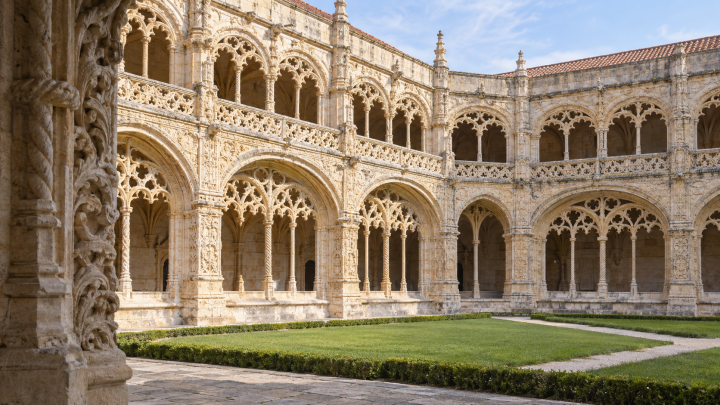
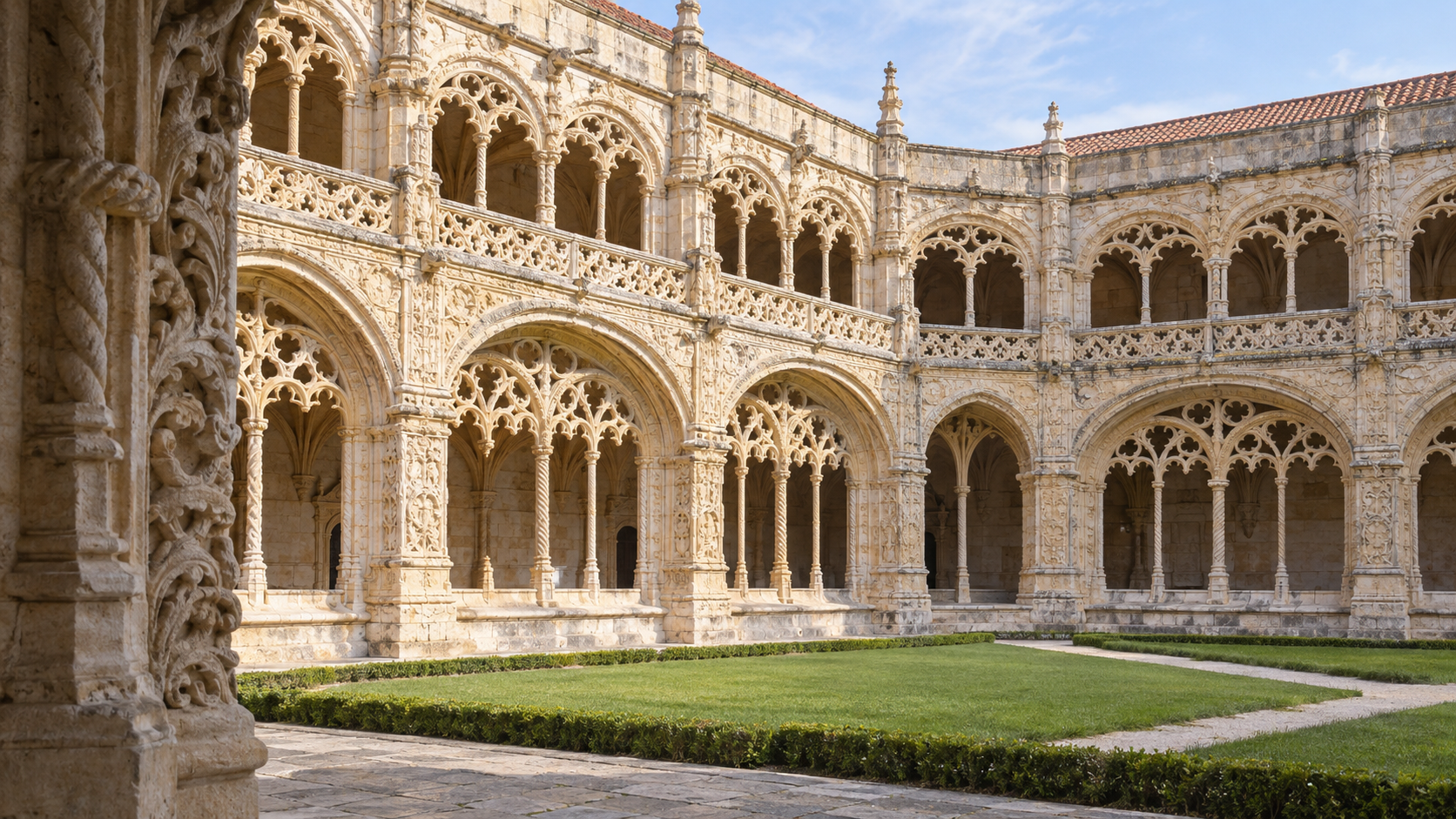
The two-story cloister shows how Manueline carvers brought religious, royal, and maritime imagery together: carved ropes and foliage frame the royal shield, the cross of the Order of Christ, and Manuel I’s emblem, the armillary sphere. The chapter house and refectory open off the cloister. Diogo de Torralva added Renaissance elements to its upper level. Later in the sixteenth century, Queen Catherine commissioned Jerónimo de Ruão to design a new chancel for the royal tombs. Its restrained classical architecture contrasts with the carved stonework of the nave. The church also contains funerary monuments to Vasco da Gama and the poet Luís de Camões.
The main structure survived the Lisbon earthquake of 1755 with relatively limited damage. Monastic life ended on 28 December 1833, when the monks were expelled and the buildings, apart from the church, were assigned to the Casa Pia de Lisboa, a charitable educational institution. This transfer preceded the nationwide suppression of men’s religious houses in 1834. A rebuilding campaign begun in 1860 transformed the former dormitory wing in the neo-Manueline style. Parts of the complex later became home to the National Museum of Archaeology and the Maritime Museum.
Portugal classified the monastery as a National Monument in 1907. In 1983, UNESCO inscribed it jointly with the nearby Tower of Belém under the title Monastery of the Hieronymites and Tower of Belém in Lisbon. The Church of Santa Maria de Belém remains an active Catholic parish. Visitors can enter the church separately from the ticketed cloister; both normally receive visitors from Tuesday to Sunday, with sightseeing in the church beginning after morning worship on Sundays. The church and lower cloister are wheelchair accessible, while the upper gallery is reached by stairs. In 2025, the monastery recorded 1,040,203 admissions, the highest total among the sites managed by Museus e Monumentos de Portugal.
References
Calado, M. (1996). O Mosteiro dos Jerónimos. IPPAR; Scala Publishers; Dias, P. (1988). A arquitectura manuelina. Livraria Civilização Editora; Espanca, T. (1956). Mosteiro dos Jerónimos de Belém. Direcção-Geral dos Edifícios e Monumentos Nacionais; UNESCO World Heritage Centre. (n.d.). Monastery of the Hieronymites and Tower of Belém in Lisbon. https://whc.unesco.org/en/list/263/
See Also:
See Also
Map