Historic City of Lamego / Cidade de Lamego (Viseu District, Douro Subregion, Portugal)
Ancient City Historic City Tourism City COUNTRIES AND TERRITORIES Portugal
Viseu District, Douro Subregion, Portugal
-
2026

Lamego’s medieval layout remains visible in the route from the hilltop castle to the cathedral below. The upper town grew around the fortress, while the lower town developed under the authority of the bishop. Settlement predates both: excavations near the Porta dos Figos, one of the gates to the castle quarter, have revealed Roman structures beneath later occupation. The earliest named bishop of Lamego, Sardinário, attended the Second Council of Braga in 572, when the region formed part of the Suebic kingdom.
The castle appears in a document of 952. After a period of shifting frontier control, Ferdinand I of León captured Lamego from Muslim forces in 1057. Under Afonso Henriques, the first king of Portugal, the city regained a resident bishop, and work on the Romanesque cathedral was under way by 1179. In 1191, Sancho I granted the cathedral jurisdiction over the lower town; Manuel I granted the city a municipal charter in 1514. A separate tradition placed Portugal’s first representative assembly, the Cortes de Lamego, in the Church of Santa Maria de Almacave in 1143. Its supposed proceedings surfaced only in the seventeenth century and are not accepted as a medieval record.
In the castle quarter, a square granite keep overlooks streets that follow the contours of the hill. A vaulted underground cistern supplied water to the walled settlement. Below, the cathedral retains its Romanesque bell tower and three carved granite portals dating from the early sixteenth century. In 1737–1738, Nicolau Nasoni painted scenes from the Old Testament on the vaults of the nave and side aisles. Panels from the cathedral’s Renaissance altarpiece, painted by Vasco Fernandes, belong to the collection of the Museu de Lamego in the former episcopal palace. Outside the centre, the Chapel of São Pedro de Balsemão preserves an early medieval horseshoe arch within a later building; the precise date of its earliest masonry remains disputed.
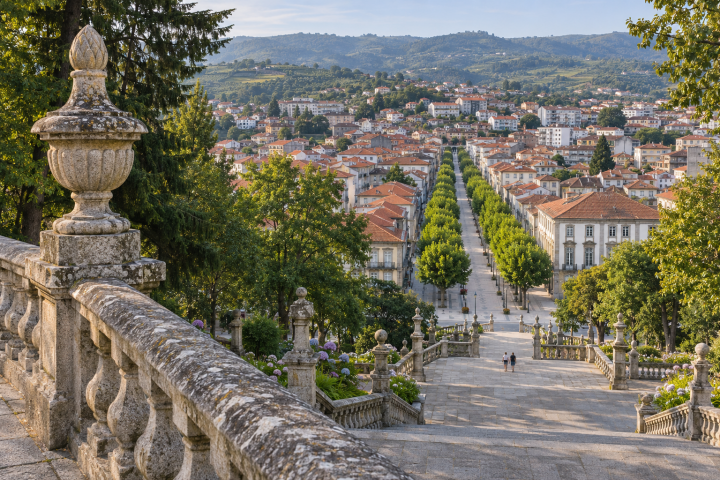
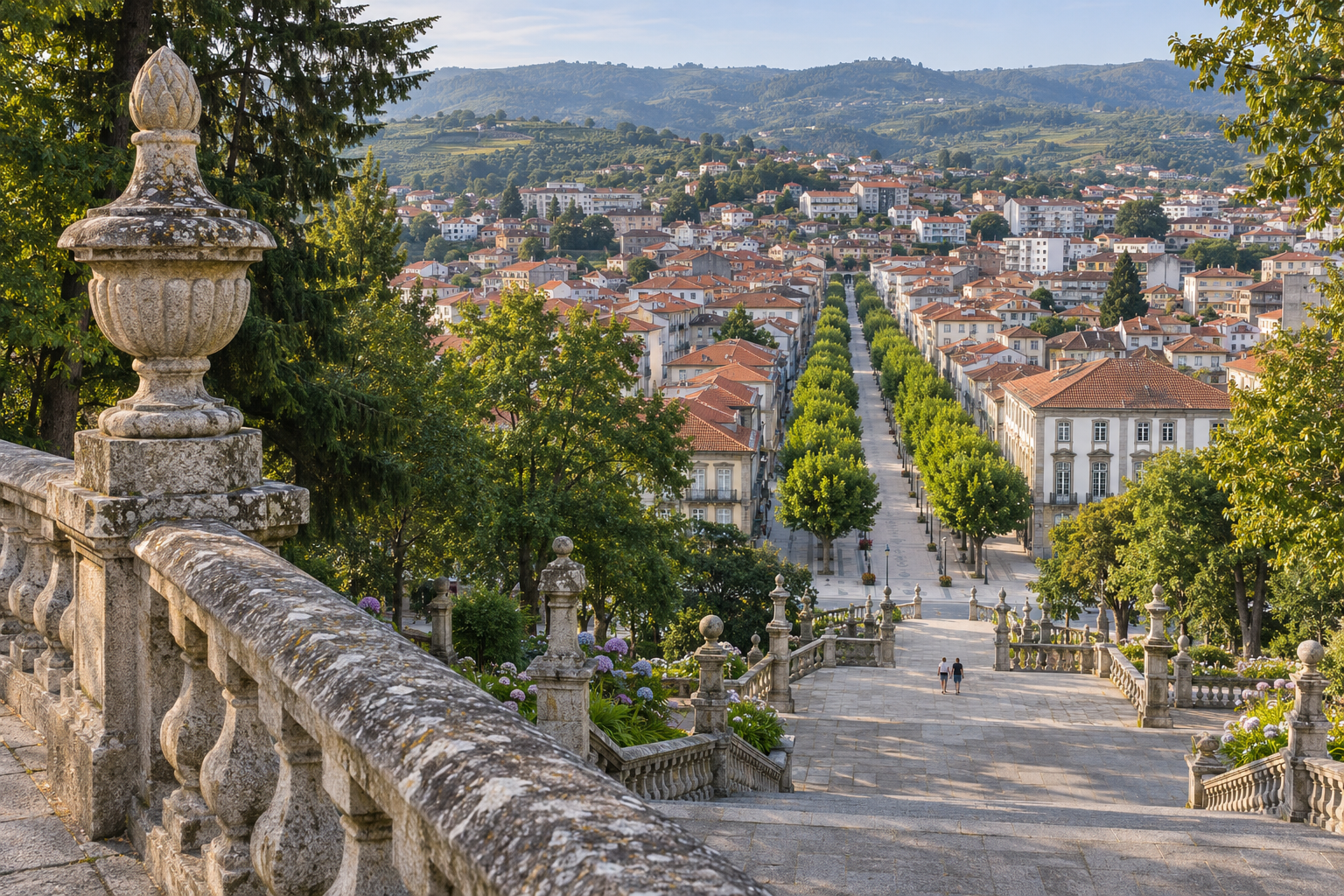
On Monte de Santo Estêvão, the Sanctuary of Nossa Senhora dos Remédios replaced a chapel commissioned in 1568. Canon José Pinto Teixeira initiated construction of the present church in 1750. Work on its granite staircase began in 1777, and the sanctuary’s north tower was completed in 1905. The 616-step ascent passes fountains and blue-and-white tile panels before reaching terraces such as the Pátio dos Reis, where statues represent the biblical House of David. The annual pilgrimage culminates on 8 September with the Procissão de Triunfo, during which pairs of oxen draw floats bearing sacred images through the city.
Wine tourism connects Lamego with both the vineyards of Távora-Varosa and the Alto Douro Wine Region. José Teixeira Rebelo Júnior was producing sparkling wine in the lower town by 1898. At the Raposeira cellars, visitors can learn how a second fermentation in the bottle produces the wine’s bubbles. Local food specialities include roast kid and bôla de Lamego, a savoury bread often filled with cured ham. Parts of the municipality lie within the Alto Douro vineyard landscape inscribed on the UNESCO World Heritage List in 2001; the historic city has no separate World Heritage designation.
References
Almeida, C. A. F. (1986). História da arte em Portugal: Vol. 3. O românico. Publicações Alfa; Costa, M. G. (1977–1992). História do bispado e cidade de Lamego (Vols. 1–6); Lacerda, A. (1942). História da arte em Portugal (Vol. 1). Portucalense Editora; Pereira, P. (2011). Arte portuguesa: História essencial. Temas e Debates – Círculo de Leitores.
See Also:
See Also
Map