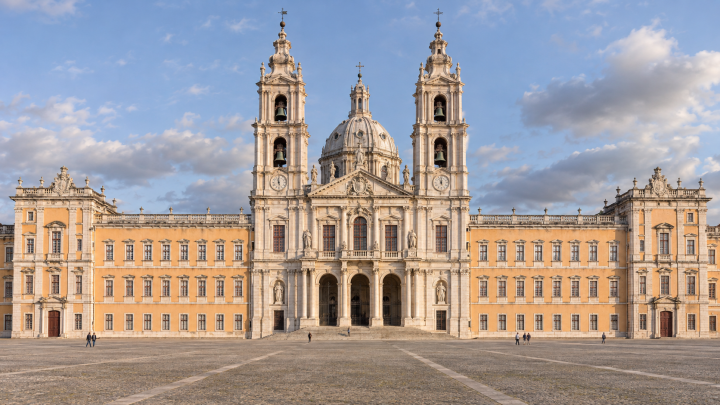
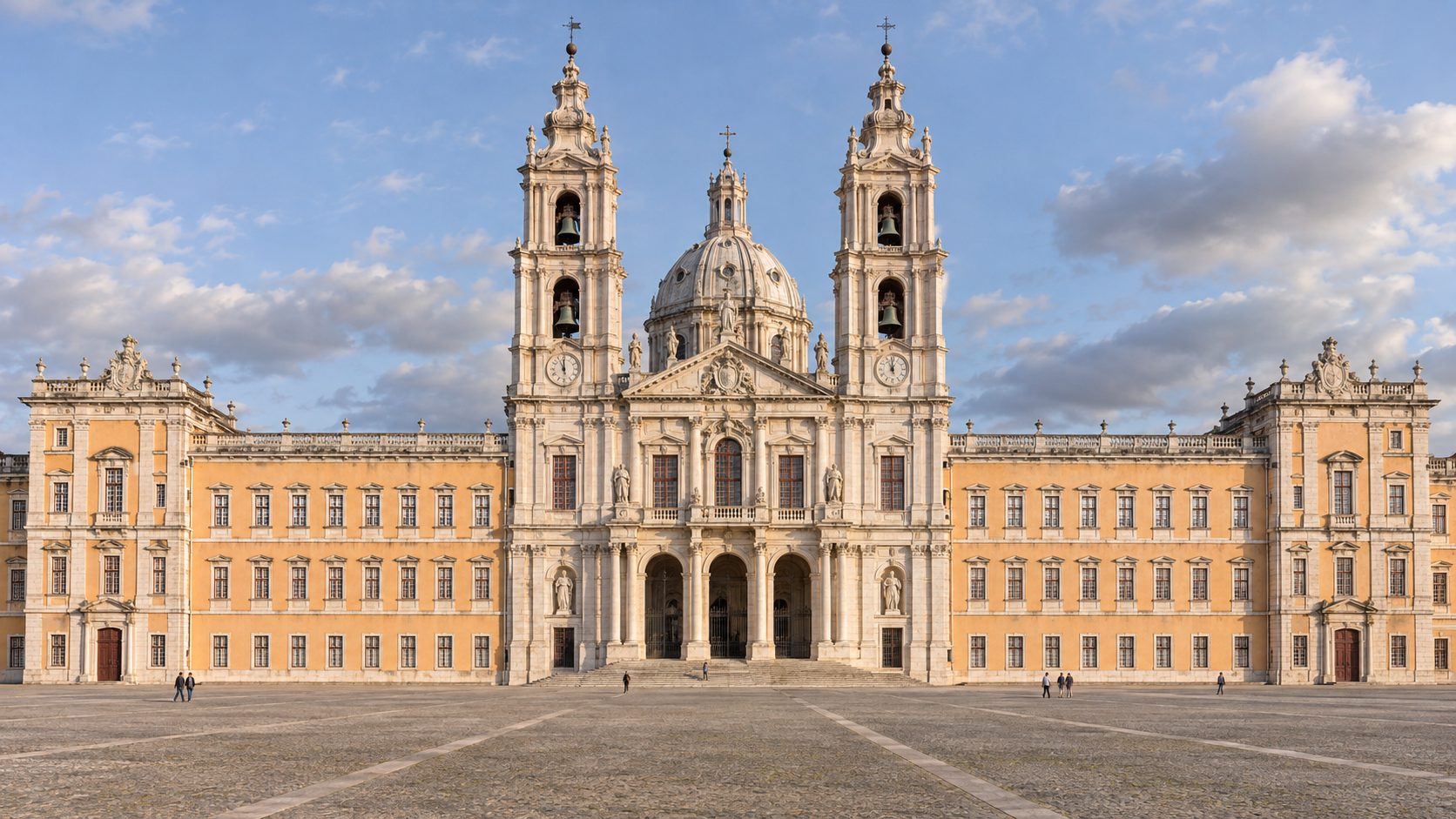
Mafra National Palace / Palácio Nacional de Mafra (Mafra, Portugal)
Cultural Heritage Destination COUNTRIES AND TERRITORIES Portugal Visitor Attractions, Culture and Heritage
Mafra, Portugal
-
2026

King John V of Portugal commissioned the complex to fulfil a vow to found a Franciscan convent if his marriage to Maria Anna of Austria produced an heir. Their first child, Princess Maria Bárbara, was born in 1711. Initially intended for thirteen friars, the convent was eventually designed to house 300 alongside a royal residence. Revenue from gold mined in colonial Brazil made construction on this scale possible. The chief architect, Johann Friedrich Ludwig, known in Portugal as João Frederico Ludovice, was born in Swabia and trained in Rome. The foundation stone was laid on 17 November 1717. The basilica was consecrated on 22 October 1730, the king’s forty-first birthday, but construction and decoration continued for decades.
Built of local lioz limestone, the palace has a sequence of rooms extending 232 metres between the royal apartments at opposite ends of the main façade. The basilica’s twin bell towers contain carillons cast in Antwerp and Liège. Inside the church, six pipe organs built between 1792 and 1807 by the Portuguese organ makers António Machado e Cerveira and Joaquim Peres Fontanes were designed to be played together. The convent’s surviving infirmary, by contrast, preserves the rooms where sick friars received care.
The palace library, known as the Casa da Livraria, holds some 30,000 volumes in a single hall. Its Rococo bookcases, designed by Manuel Caetano de Sousa, were installed in 1776. The collection includes illuminated manuscripts, early printed books and scores composed for the basilica’s organs. In 1754, Pope Benedict XIV granted the library permission to keep works on the Church’s Index of Prohibited Books. Colonies of bats help protect the collection by feeding on insects that damage paper and wood.
The royal family used Mafra for religious festivals and for hunting in the estate’s enclosed park, the Tapada. After Portugal abolished the religious orders in 1834, military institutions occupied the convent; the basilica became a parish church in 1836. King Manuel II spent his last night in Portugal at Mafra on 4–5 October 1910 before leaving for exile. The building received national monument protection under decrees of 1907 and 1910. In 2019, UNESCO inscribed the palace, basilica and convent together with the formal Cerco Garden and the former royal hunting park on the World Heritage List.
The palace is also a destination for literary tourism. José Saramago’s 1982 novel Memorial do Convento (Baltasar and Blimunda) recounts the construction of Mafra from the perspective of those who built it. A literary route connects the palace with places in Lisbon and Loures that appear in the novel. Portugal’s National Music Museum opened in the complex in November 2025, and the palace library reopened after conservation work in January 2026. The palace normally admits visitors from Wednesday to Monday; researchers may consult the library by appointment. As of November 2026, the palace ticket office listed the basilica as temporarily closed for restoration.
References
Castilho, J. M. (2011). O Palácio Nacional de Mafra: Arquitectura e poder. Imprensa Nacional-Casa da Moeda; Curvelo, A. (2014). Mafra: Palácio, basílica, convento. Scala Publishers; Ludovice, J. F. (2005). O Convento de Mafra na época doseana. Almedina; UNESCO World Heritage Centre. (n.d.). Royal Building of Mafra – Palace, Basilica, Convent, Cerco Garden and Hunting Park (Tapada). https://whc.unesco.org/en/list/1573
See Also
Map