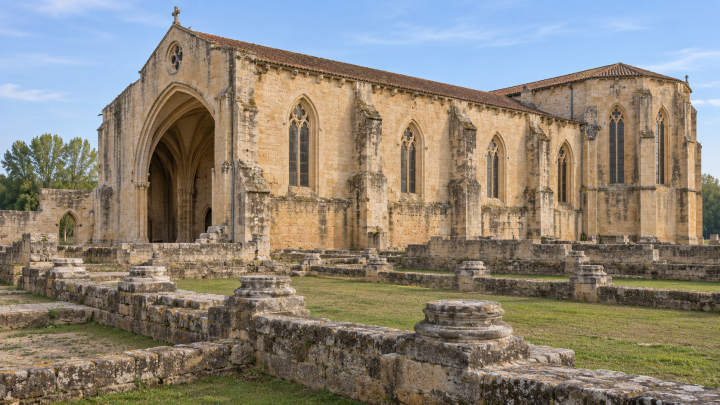
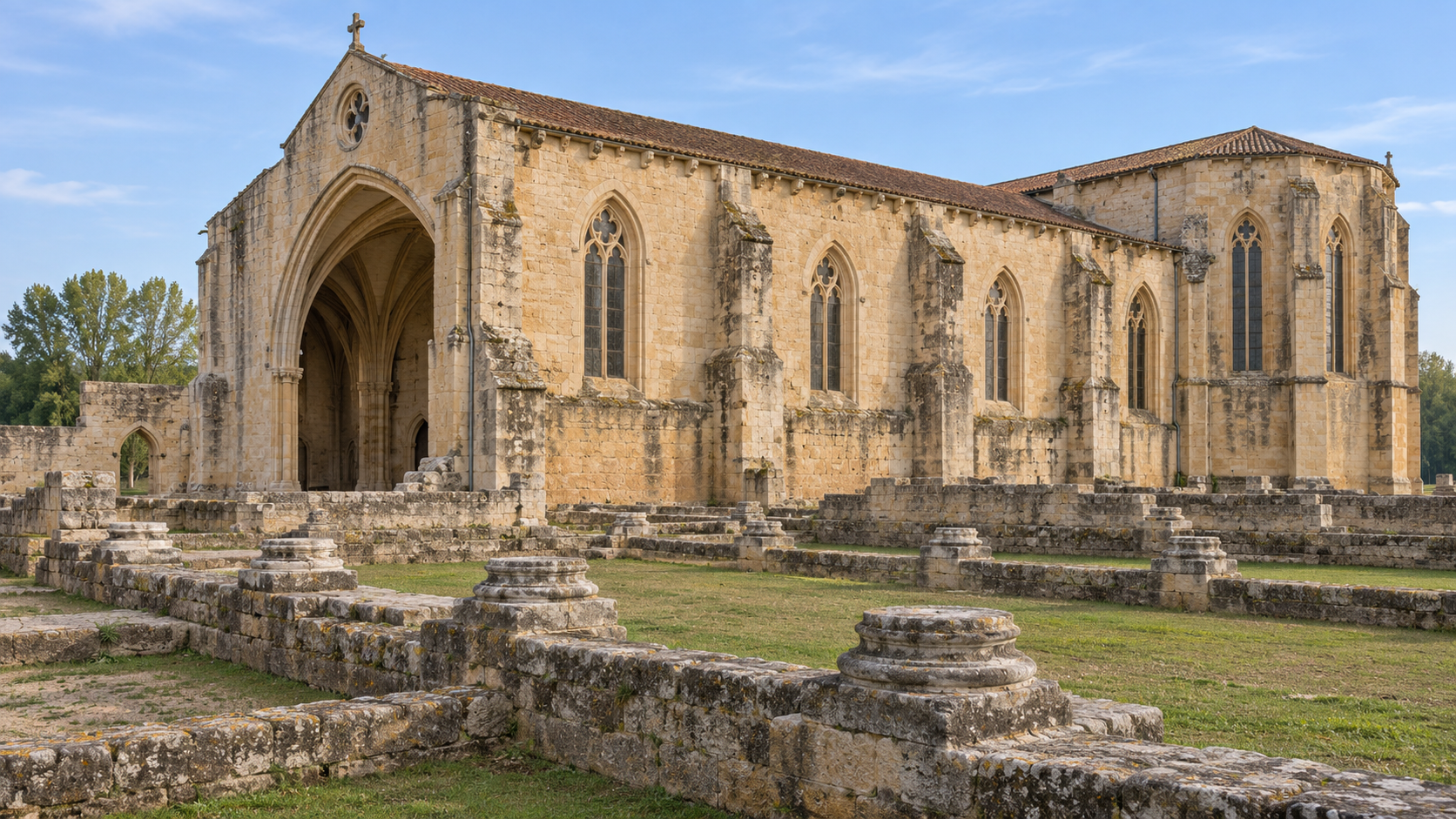
Monastery of Santa Clara-a-Velha (Coimbra, Portugal)
Cultural Heritage Destination COUNTRIES AND TERRITORIES Portugal Visitor Attractions, Culture and Heritage
Portugal, 2026
-
2026

In 1283, Dona Mor Dias, a noblewoman of Coimbra, received permission to establish a convent for the Order of Saint Clare. The foundation of the first community is generally dated to 1286. A dispute with the canons of Santa Cruz over the property she had given the convent led to its dissolution in 1311. Queen Elizabeth of Aragon, known in Portugal as Rainha Santa Isabel, refounded the convent in 1314 and financed its rebuilding. She had a palace nearby and chose the convent church as her burial place.
The master builder Domingos Domingues, who had previously worked at the Monastery of Alcobaça, directed the first phase of construction. His successor, Estêvão Domingues, oversaw the completion of the church, consecrated in 1330, and the construction of the cloister. The church has no transept: the central nave leads directly to a polygonal apse. Stone vaults cover both the nave and its two side aisles, which rise to nearly the same height. This was unusual for a Portuguese mendicant church of the period, when timber roofs were customary. South of the church, the cloister follows an irregular trapezoidal plan.
The Mondego flooded the convent in 1331, just a year after the consecration. The nuns repeatedly raised the floors as floodwater and sediment entered the buildings. By the early seventeenth century, they had built an upper floor along the length of the church and ceased using the level below. In 1677, the community moved to Santa Clara-a-Nova on the nearby hill of Monte da Esperança, taking the queen’s remains and tomb. The old convent grounds became farmland. Parts of the upper church served as living quarters, a hayloft, and animal stalls while the lower church and cloister lay buried in silt.
Portugal classified the monastery as a National Monument in 1910, and state conservation work began in the 1930s. Between 1995 and 2000, archaeologists used pumps to keep the excavations dry as they uncovered the lower church and cloister. A barrier around the excavated area subsequently limited groundwater seepage. The ruins and an interpretation centre opened to the public in April 2009. Finds on display include rosaries, rings, porcelain, and fine glassware, documenting both religious devotion and the personal possessions of women who lived in the convent.
Flooding in 2016 prompted further repairs to the church paving, decorative tiles, and outdoor walkways. The site reopened in June 2023 and closed again in October 2025 for work on the interpretation centre and grounds. As of November 2026, the official ticketing service still listed regular admission as temporarily suspended. Portugal’s heritage service also offers a virtual tour of the monastery.
References
Alarcão, J. (1998). Coimbra: A formative city. Almedina; Direção-Geral do Património Cultural. (n.d.). Mosteiro de Santa Clara-a-Velha: História e recuperação [Dossier de monumento nacional]; Gomes, M. V. (2007). O Mosteiro de Santa Clara-a-Velha de Coimbra: Da fundação à recuperação. IPPAR; Torres, C., & Macias, S. (2010). A intervenção arqueológica e a musealização do Mosteiro de Santa Clara-a-Velha. Revista de Arqueologia e Arquitetura, 14(2), 45–62.
See Also
Map