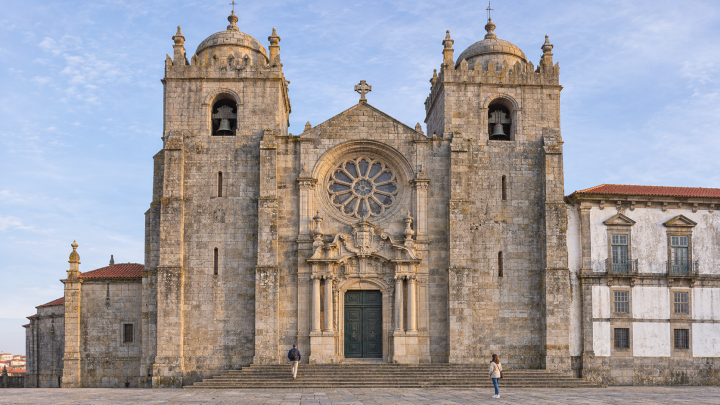
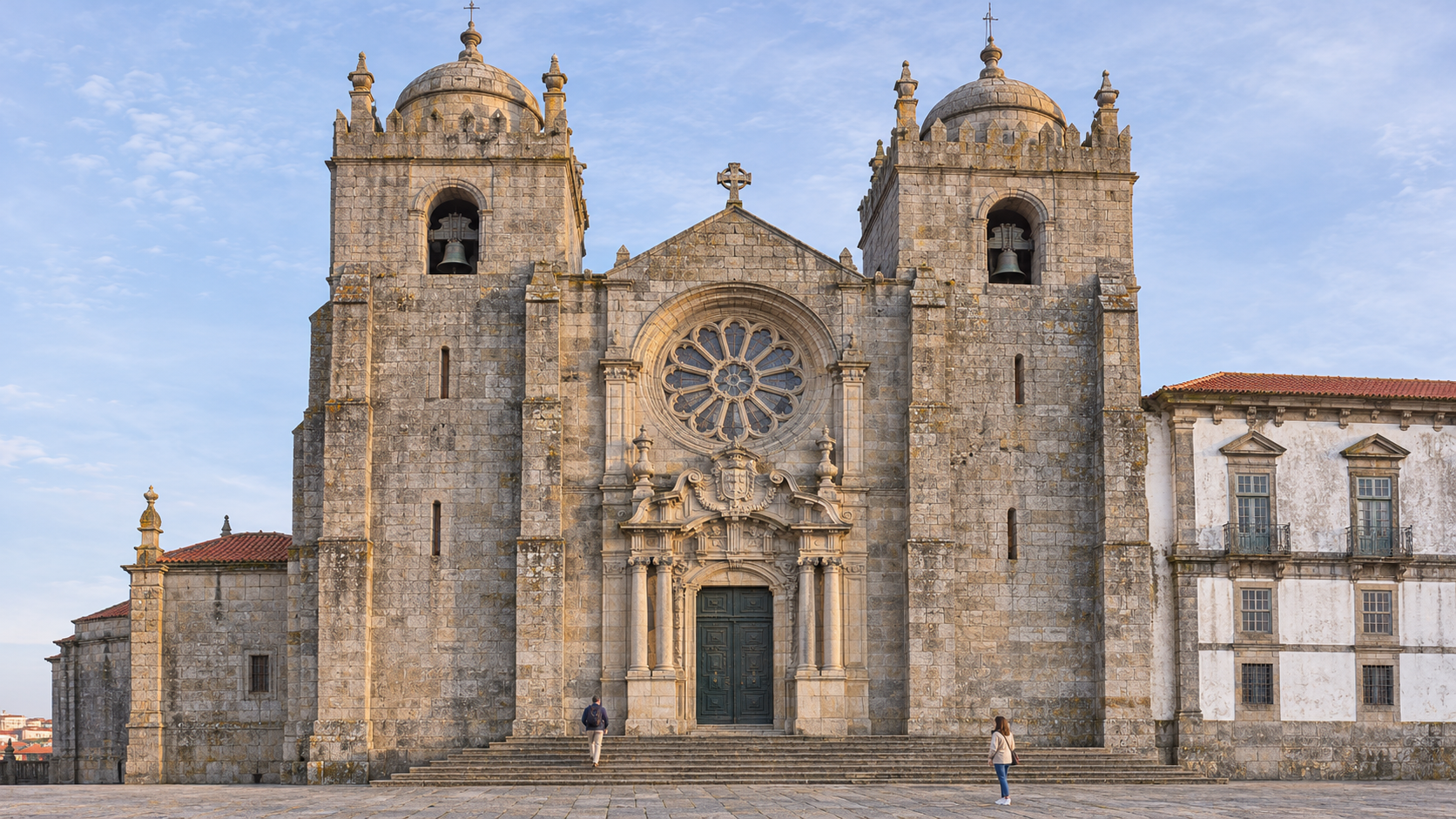
Porto Cathedral / Sé Catedral do Porto (Porto, Portugal)
UNESCO World Heritage Destination UNESCO World Heritage
Porto, Portugal
-
2026

The tower stands at the western end of a complex built for the Brotherhood of Clerics (Irmandade dos Clérigos). Three confraternities, including the Brotherhood of Poor Clerics, united on 18 April 1707 to care for priests in sickness and poverty. The Brotherhood’s surviving book of building records opens with its decision of 31 May 1731 to erect a church on donated land at Campo do Olival. The Tuscan painter and architect Nicolau Nasoni (1691–1773) made use of the sloping site: the church façade faces downhill toward Rua dos Clérigos, while the Brotherhood’s former quarters and infirmary connect the church to the bell tower on higher ground.
Work on the church foundations began in April 1732. The main building was substantially complete by 1749, although the enlargement and furnishing of the chancel continued. Nasoni presented his design for the bell tower in 1753, and construction began the following year. In July 1763, workers placed an iron cross at the summit and a statue of Saint Paul in the niche above the entrance, marking the tower’s completion. Nasoni became a lay member of the Brotherhood and was buried in the church in 1773.
The granite tower rises approximately 75 meters through six tiers. The carving becomes more elaborate toward the summit, where the open arches of two belfries interrupt the mass of the stone. The Brotherhood counts 225 steps to the viewpoint; Portugal’s national heritage inventory records 240. Inside the church, a gallery follows the curve of the elliptical nave. Beyond it stands the colored marble altarpiece designed by Manuel dos Santos Porto.
The tower’s visibility made it useful well beyond the church. In an agreement dated 18 March 1843, the Brotherhood and the Porto Commercial Association arranged for signals to be displayed from the tower when the mail from England reached the city. Merchants could learn of its arrival simply by looking up. The carillon heard today is a later addition: its 49 bells were cast in the Netherlands, and the instrument was inaugurated on 24 June 1995.
Portugal classified the church and tower as a National Monument in 1910. Their UNESCO recognition comes through the inscription of Porto’s historic center in 1996 under criterion (iv), which recognizes the development of the city as a whole. Restoration began in 2013, the 250th anniversary of the tower’s completion. When the complex reopened on 12 December 2014, the Brotherhood’s former private rooms became part of a museum displaying paintings, sculpture, textiles, and silverwork. The former infirmary, which treated sick priests until the late nineteenth century, now houses the Christus collection of sacred art.
The church remains open for worship. A standard visitor ticket covers the museum and the climb to the summit, which overlooks Porto’s rooftops, the Douro, and Vila Nova de Gaia on the opposite bank. The complex opens daily, with evening climbs on selected dates. A lift serves the museum; for visitors unable to climb the tower, the accessible Sala A+ displays live views from cameras at the summit. On 24 April 2026, the complex marked its ten-millionth visitor, a cumulative figure for the church, museum, and tower together.
References
Real, M. L. (1993). O românico da Sé do Porto e a arquitectura peninsular. Câmara Municipal do Porto; Rosas, L. (2000). A Sé do Porto: História, arte e restauro. Edições Afrontamento; Smith, R. C. (1966). Nicolau Nasoni, arquitecto do Porto. Livros Horizonte; UNESCO World Heritage Centre. (n.d.). Historic Centre of Oporto, Luiz I Bridge and Monastery of Serra do Pilar. https://whc.unesco.org/en/list/755/
See Also
Map