University of Coimbra – Alta and Sofia (Coimbra, Portugal)
UNESCO World Heritage Destination UNESCO World Heritage Site COUNTRIES AND TERRITORIES Portugal UNESCO World Heritage
Coimbra, Portugal
-
2026

The University of Coimbra, the oldest university in Portugal, began in Lisbon. On 1 March 1290, King Dinis signed the charter Scientiae thesaurus mirabilis, establishing a studium generale for the teaching of arts, canon law, civil law, and medicine. Pope Nicholas IV confirmed the foundation on 9 August of that year. The university first moved to Coimbra in 1308, returned to Lisbon in 1338, moved back to Coimbra in 1354, and returned to Lisbon in 1377. In 1537, King João III established it permanently in Coimbra, where the former Royal Palace of Alcáçova became its seat. Its students came from across the Portuguese empire, including Brazil; through its graduates, Coimbra’s teaching and institutional practices reached well beyond Portugal.
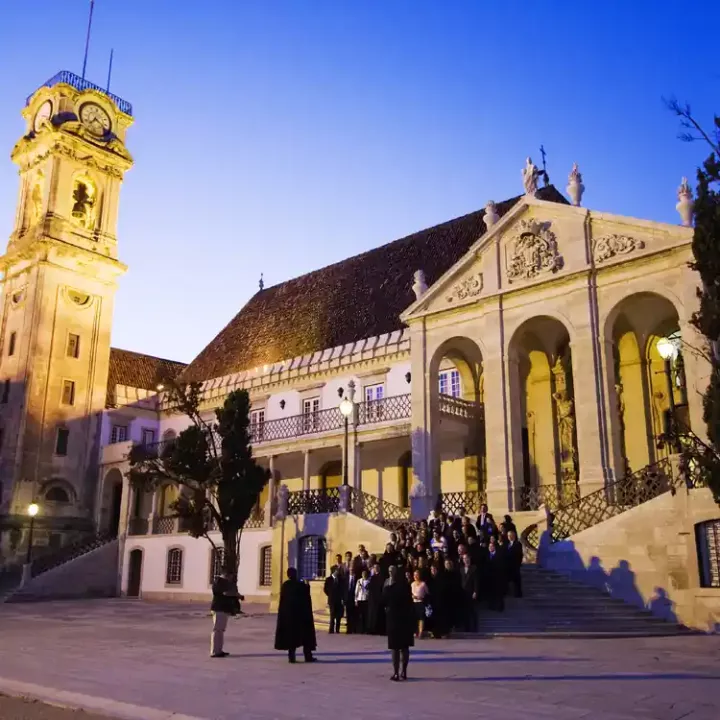
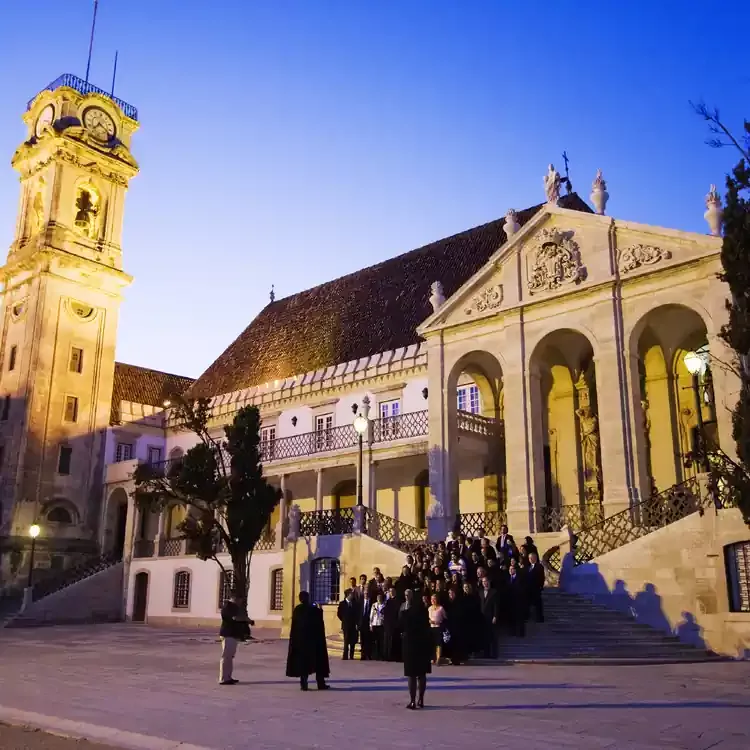
The two parts of the World Heritage property illustrate how the university took root in the city. In the Alta, or Upper Town, the Paço das Escolas occupies the site of a fortress built under Islamic rule in the late tenth century and later used as a Portuguese royal residence. Its former throne room, now the Sala dos Capelos, remains the setting for doctoral ceremonies and the installation of rectors. St. Michael’s Chapel, once the private royal oratory, preserves a Manueline portal, tiled walls, and a Baroque organ dating from 1737. The organ is still played at services and concerts.
In the lower town, Rua da Sofia was laid out in 1535, shortly before the university’s permanent transfer. Its broad, straight course provided space for religious orders to establish colleges where students could live, worship, and study. These included the colleges of Nossa Senhora do Carmo, Nossa Senhora da Graça, and São Tomás de Aquino. After Portugal abolished the religious orders in 1834, the buildings acquired different uses. The former College of São Tomás, for example, was acquired by the Ministry of Justice in 1928 and adapted as Coimbra’s courthouse. The street thus preserves the plan of a Renaissance college district even where the buildings no longer serve an educational purpose.
The Biblioteca Joanina, built at the Paço das Escolas between 1717 and 1728 with the support of King João V, preserves two quite different aspects of university life. On the principal floor, gilded bookcases line the Baroque reading rooms. The architect has not been securely identified, although the master builder Gaspar Ferreira is documented as supervising the bookcases and other woodwork. Bats that roost in the library help protect its collections by feeding on insects at night. Below the reading rooms, the surviving cells of the Academic Prison recall the university’s former jurisdiction over its own community, a privilege abolished in 1834.
The reforms of 1772, directed by the Marquis of Pombal, gave experimental science a larger place in the curriculum. The Botanical Garden provided living plants for study, while the purpose-built Chemistry Laboratory gave students a place to observe and conduct experiments. The laboratory now forms part of the university’s Science Museum. A later intervention transformed the Alta on a different scale: beginning in the 1940s, the Estado Novo regime demolished residential streets and college buildings to make way for a monumental University City. The new faculty buildings and stairways visible today are therefore also evidence of the loss of part of the old neighborhood and the displacement of its residents.
UNESCO inscribed the property on the World Heritage List in 2013 under criteria (ii), (iv), and (vi), recognizing the university’s influence on institutions in the Portuguese-speaking world, the integration of university buildings into the city, and the continuity of its academic culture. In 2019, a boundary extension brought the Machado de Castro National Museum into the property. The ensemble is also protected under Portuguese law. Conservation projects at the Paço das Escolas have included the University Tower, the Via Latina colonnade, and the Minerva Stairs, all of which remain part of a working university.
Tourism is also a subject of teaching and research at Coimbra. The Faculty of Arts and Humanities introduced its first undergraduate tourism degree in 2003. It now offers a bachelor’s degree in Tourism, Territory and Heritage, a master’s in Sustainable Tourism, Heritage and Development, and a doctorate in Tourism, Heritage and Territory. The master’s curriculum includes a course specifically on UNESCO heritage and tourism management. A separate master’s degree, Food: Sources, Culture and Society, examines food history and culinary heritage. Applied training in the city belongs to distinct institutions: the Polytechnic University of Coimbra offers a gastronomy degree in partnership with the Coimbra School of Hospitality and Tourism, which also teaches hotel management, cookery, and pastry.
Visitors can explore the palace, chapel, library, and science collections on guided or independent visits. Entry to the Joanina Library is timed and takes visitors through the former Academic Prison before they reach the reading rooms. In 2025, the university’s visitor circuit recorded 379,578 visitors. Academic traditions also draw people into the streets beyond the ticketed monuments: the annual Queima das Fitas student festival opens with the Serenata Monumental, a midnight performance of Coimbra’s distinctive student song tradition, Canção de Coimbra, also known as Coimbra fado.
References
Alarcão, J. (2008). Coimbra: Cidade universitária. Imprensa da Universidade de Coimbra; Bandeira, J. M. (2014). Universidade de Coimbra: Alta e Sofia – Património mundial. Edições Almedina; Craveiro, M. L. (2011). O Renascimento em Coimbra: Modelos e leituras na arquitetura dos colégios da Sofia. CECH / Imprensa da Universidade de Coimbra; Mendes, J. A. (2013). A Universidade de Coimbra no tempo e no espaço. Reitoria da Universidade de Coimbra; UNESCO World Heritage Centre. (2013). University of Coimbra – Alta and Sofia. World Heritage List. https://whc.unesco.org/en/list/1387
See Also
Map