Stock Exchange Palace / Palácio da Bolsa (Porto, Portugal)
Cultural Heritage Destination COUNTRIES AND TERRITORIES Portugal Visitor Attractions, Culture and Heritage
(Porto, Portugal
-
2026

The palace stands beside the Church of São Francisco, on the site of the Franciscan convent damaged by fire during the siege of Porto in 1832. In 1841, Queen Maria II granted the property to the Porto Commercial Association (Associação Comercial do Porto), founded in 1834, to house its headquarters, a merchants’ exchange and a commercial court. The foundation stone was laid on 6 October 1842. The architect Joaquim da Costa Lima Júnior incorporated the former cloister into his design. By 1850, the principal façade overlooking Praça do Infante D. Henrique was complete. The palace hosted an industrial exhibition in 1861, although work on its interiors continued into the early twentieth century.
The former cloister became the Pátio das Nações (Courtyard of Nations), where merchants gathered to conduct business. Tomás Soller revised the design of its iron-and-glass roof and supervised its completion. Beneath it, twenty painted heraldic panels represent Portugal’s international trading connections. The courtyard’s ceramic mosaic floor, inspired by ancient pavements at Pompeii, served as the trading floor of Porto’s official stock exchange, inaugurated in 1891 and active here until the mid-1990s. The association’s surviving telegraph, used to relay information about cargo entering the Douro estuary, illustrates how closely business in the palace depended on news from the port.
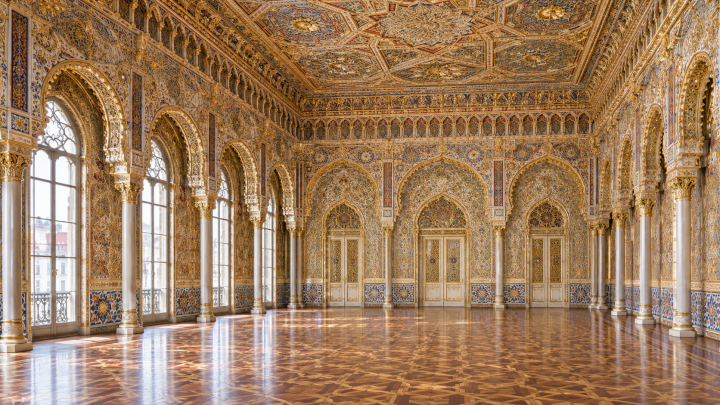
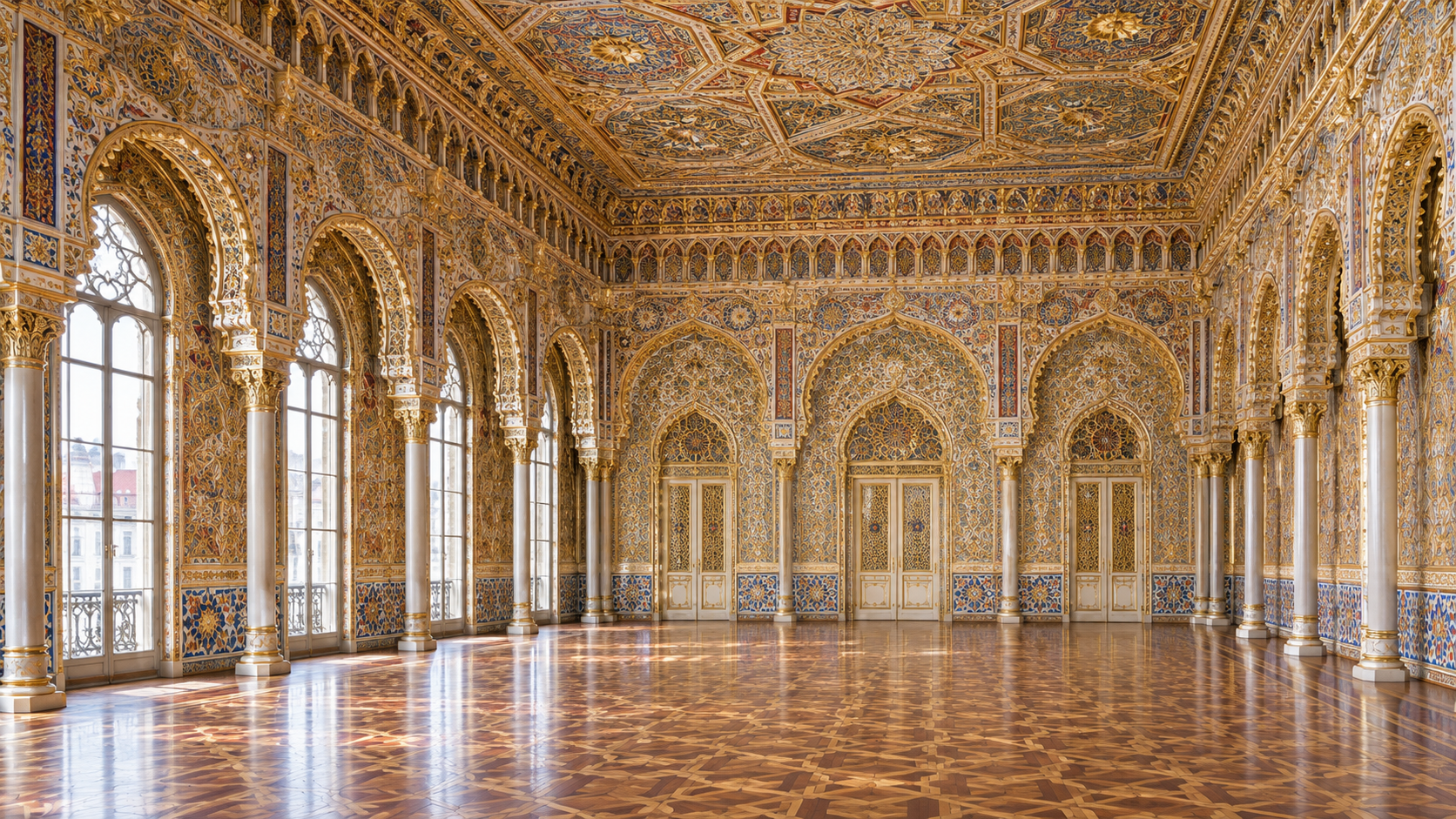
The granite ceremonial staircase and the Salão Árabe (Arabian Room) were designed by Gustavo Adolfo Gonçalves e Sousa. Work on the hall began in 1862, and it opened on 12 June 1880 during commemorations of the Portuguese poet Luís de Camões. Its design draws on the Alhambra in Granada: arches support a gallery around the oval room, while gilded and painted stucco rises above a patterned floor of mahogany, rosewood and satinwood. Other rooms use different materials to striking effect. In the General Assembly Room, for example, the apparent wood panelling is painted plaster.
Following the establishment of the Portuguese Republic, the association handed the building to Porto City Council in February 1911. It regained possession in 1918 and remains the palace’s owner and occupant. Portugal classified the building as a National Monument in 1982. It also forms part of the UNESCO World Heritage property Historic Centre of Oporto, Luiz I Bridge and Monastery of Serra do Pilar, inscribed in 1996. Conservation work has included restoration of the courtyard and its roof in 2007–2008 and of the Arabian Room in 2009–2010.
The palace hosts official receptions, concerts and conferences. It is also a venue for Essência do Vinho, a wine exhibition that brings producers and visitors into the former exchange. Public visits are by guided tour, last approximately thirty minutes and are offered in Portuguese, English, French and Spanish.
References
Cardoso, A. (1994). O Palácio da Bolsa. Associação Comercial do Porto; Duarte, J. A. (2005). O Salão Árabe do Palácio da Bolsa. Edições Afrontamento; Real, M. L. (1996). O Palácio da Bolsa e a burguesia do Porto no século XIX. IPPAR; UNESCO World Heritage Centre. (n.d.). Historic Centre of Oporto, Luiz I Bridge and Monastery of Serra do Pilar. https://whc.unesco.org/en/list/755/
See Also
Map