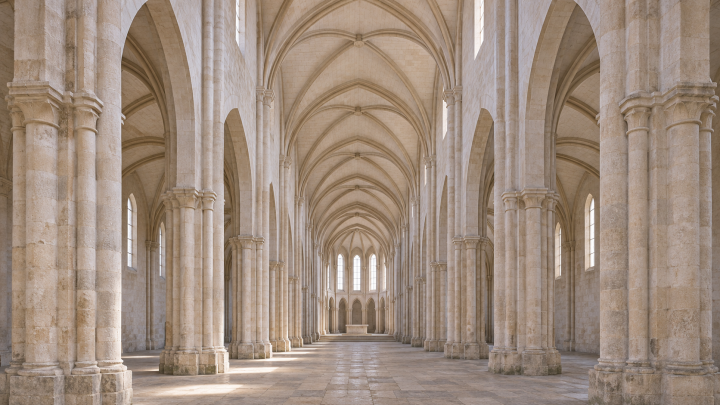
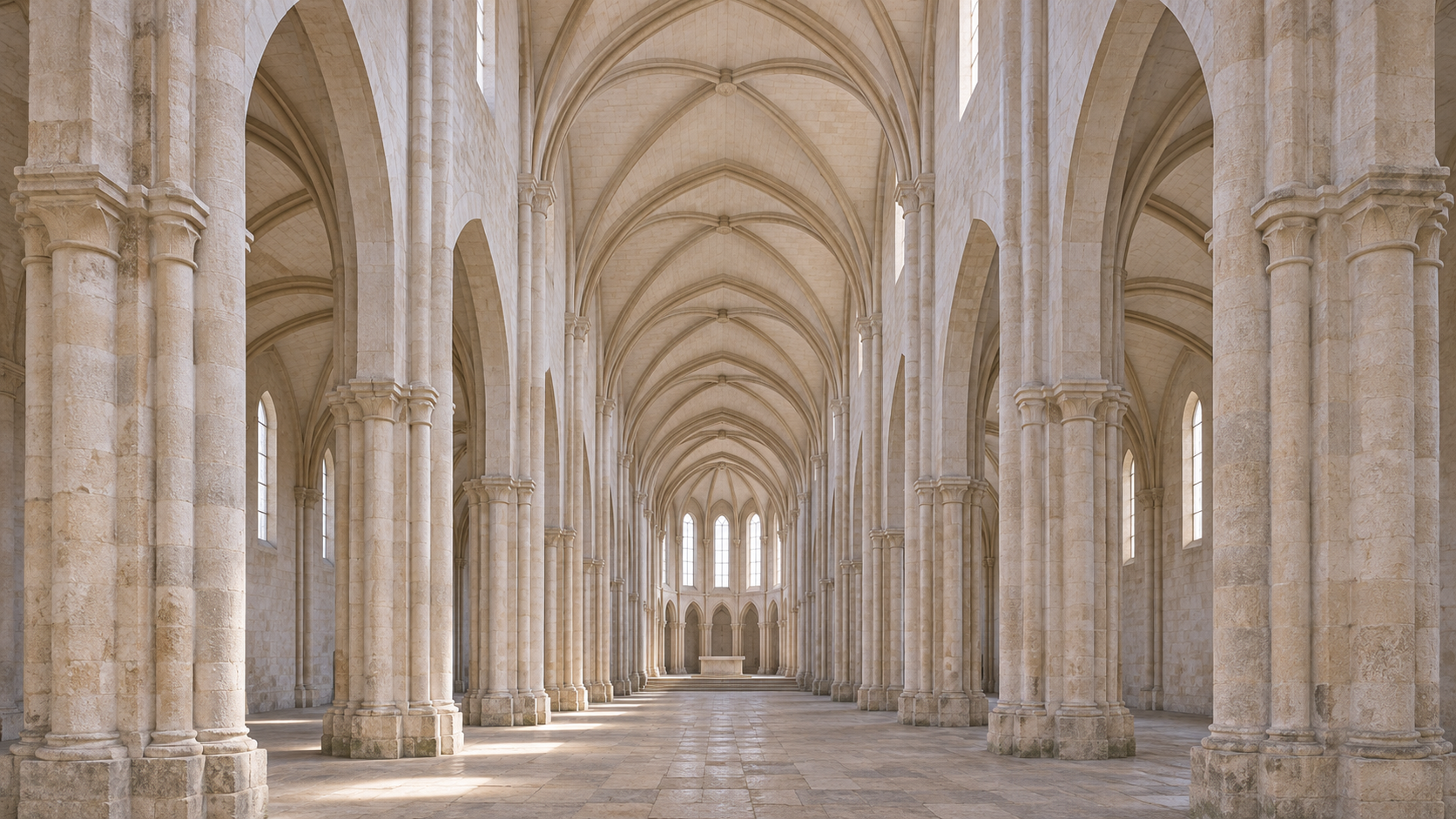
Monastery of Alcobaça / Mosteiro de Santa Maria de Alcobaça (Alcobaça, Portugal)
UNESCO World Heritage Destination UNESCO World Heritage
Alcobaça, Portugal
-
2026

On 8 April 1153, King Afonso Henriques granted land between the castles of Leiria and Óbidos to Bernard, abbot of Clairvaux. The grant established the abbey; construction of the surviving church began around 1178, and its consecration took place in 1252. Alcobaça became the principal Cistercian house in Portugal. On the surrounding estates, known as the Coutos de Alcobaça, the monks established farms and encouraged settlement. The abbey was also a center of learning: its scribes copied manuscripts, many of which are now held by the National Library of Portugal.
The church is among Portugal’s earliest fully Gothic buildings. Built of local limestone on a Latin cross plan, it has a long central nave flanked by aisles of nearly the same height. Repeated bays and restrained carving draw the eye toward the choir, where a passage curves behind the high altar and opens onto a series of chapels. The more elaborate west façade dates largely from an early eighteenth-century Baroque remodeling.
The tombs of Pedro I and Inês de Castro stand in opposite arms of the transept. Pedro commissioned them around 1360, after Inês was killed at Coimbra in 1355 on the orders of his father, King Afonso IV. Angels surround the recumbent figures; the carvings on Inês’s tomb depict the Last Judgment, while Pedro’s include the Wheel of Life. Although the tombs were conceived as a pair, their present arrangement facing one another dates from 1957.
The Cloister of Silence, built under King Dinis, probably between 1308 and 1311, connected the church with the chapter house, dormitory, and refectory. João de Castilho later added an upper gallery. In the refectory, a monk read aloud from a stone pulpit during meals. The adjoining eighteenth-century kitchen preserves a large central chimney faced with glazed tiles and a washing basin fed by a water channel. These fittings show how the abbey’s waterworks served the community in its daily life.
Flooding damaged the monastery in 1772, and French troops defaced the royal tombs during the Peninsular War in 1810–1811. The monks left in 1833, a year before Portugal formally suppressed the men’s religious orders. Parts of the complex subsequently housed a military barracks, a courthouse, and a municipal library; the refectory even served as a theater before its restoration. Portugal classified the abbey as a National Monument in 1907 and explicitly included the two royal tombs in the 1910 decree. UNESCO inscribed the monastery on the World Heritage List in 1989.
The church remains a place of worship, and visitors can see the royal tombs free of charge. A ticket gives access to the cloister and the former monastic living quarters, including the refectory and kitchen. The monastery hosts the Cistermúsica festival and an international fair devoted to sweets and liqueurs associated with convents and monasteries. A separate part of the complex, arranged around the Rachadouro Cloister, opened as a hotel in 2022.
References
Cocheril, M. (1986). Routier des abbayes cisterciennes du Portugal (2e éd., revue, corrigée et annotée par G. Leroux). Fondation Calouste Gulbenkian, Centre culturel portugais; Gusmão, A. (1956). A arquitectura da igreja de Alcobaça. Livraria Bertrand; Real, M. L. (2001). O Mosteiro de Alcobaça: Fundação, arquitectura e arte. IPPAR; Scala Publishers; UNESCO World Heritage Centre. (n.d.). Monastery of Alcobaça. https://whc.unesco.org/en/list/505/
See Also:
See Also
Map