Pena National Palace / Palácio Nacional da Pena (Sintra, Portugal)
UNESCO World Heritage Destination COUNTRIES AND TERRITORIES Portugal UNESCO World Heritage
Sintra, Portugal
-
2026

An earlier chapel marked the site when King Manuel I ordered the construction of the Royal Monastery of Our Lady of Pena in 1503. The monastery passed to the Order of Saint Jerome. Although the earthquake of 1755 damaged the buildings, the monks remained until Portugal dissolved the religious orders in 1834. The monastery church, cloister, chapter house and refectory survived and became part of the palace. The former church, adapted as the palace chapel, retains an altarpiece carved from alabaster and local limestone between 1529 and 1532.
In 1838, Ferdinand II, consort of Queen Maria II, purchased the monastery and surrounding land with his own funds. He initially intended to adapt the existing buildings as a summer residence, but expanded the project to include a new wing. The German mining engineer Baron Wilhelm Ludwig von Eschwege supervised the work, with both Ferdinand and Maria taking part in its design. Construction began around 1840. The main buildings were substantially complete by 1854, although work on the interiors continued into the 1860s. The former monastery, known as the Old Palace, housed private apartments; the New Palace contained the state rooms used for receptions.
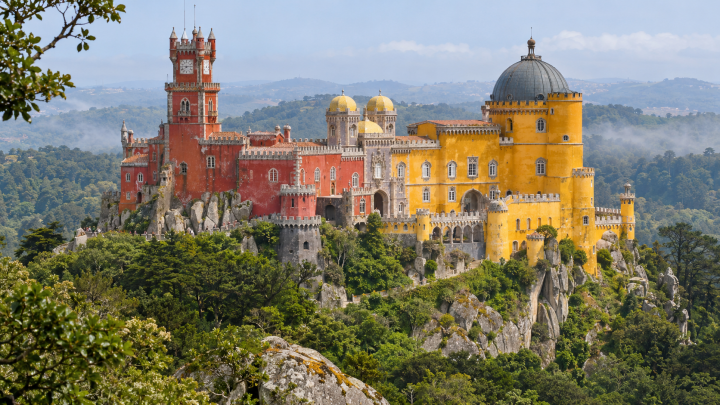
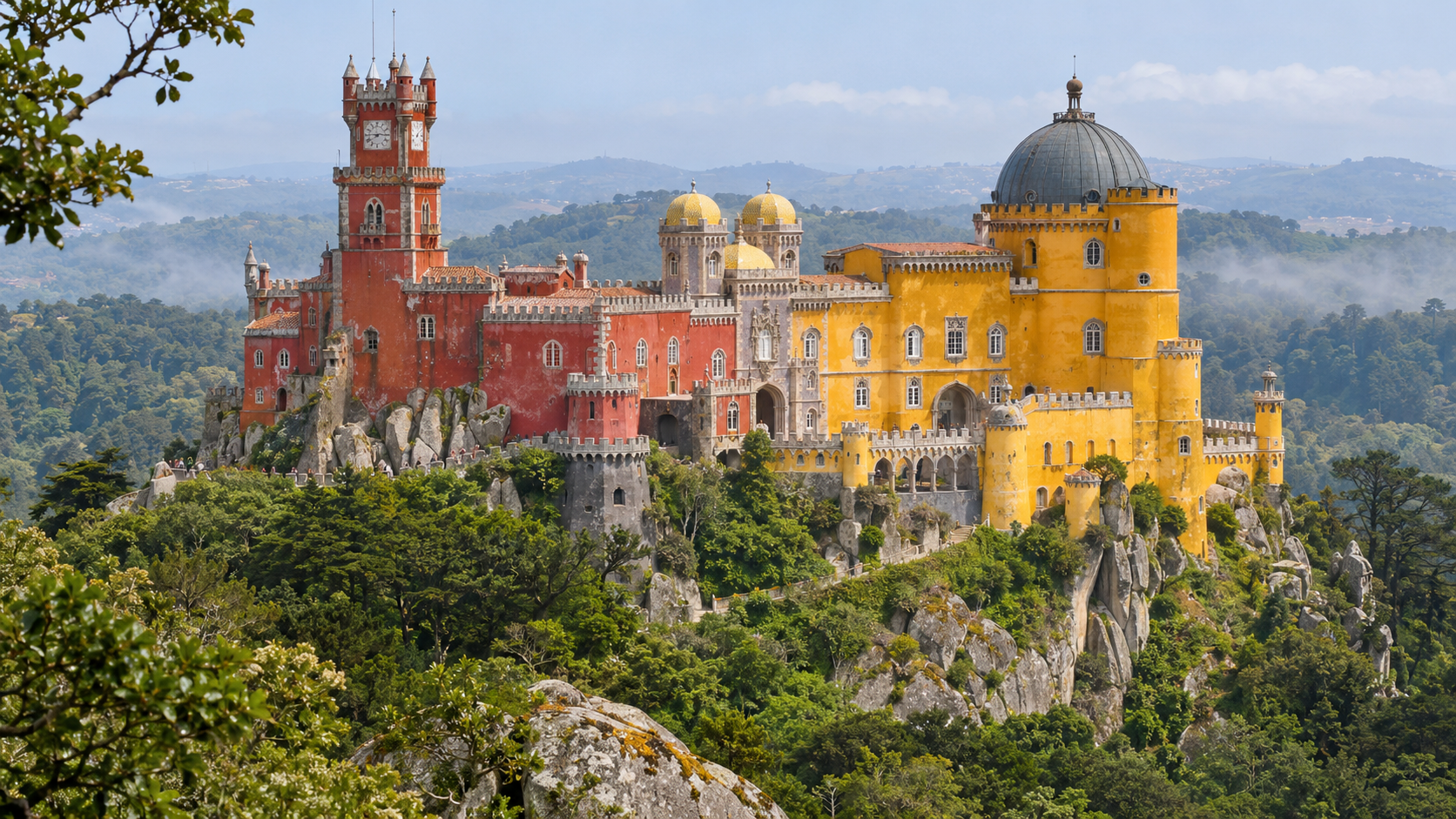
Colour distinguishes the two wings: the former monastery is rose-red and the New Palace ochre-yellow. A drawbridge, battlements and lookout towers give the residence the silhouette of a castle. Its ornament draws on Gothic, Moorish, Renaissance and Portuguese Manueline architecture. Above the Triton Tunnel, a carved window recalls the sixteenth-century chapter-house window at the Convent of Christ in Tomar. At the Triton Gateway, shells and coral beneath the figure give way to a tree and grapevines above it, representing the passage from sea to land.
Ferdinand laid out winding paths through the 85-hectare park to connect viewpoints, lakes and groves. Asian camellias, introduced in the 1840s, became a feature of the winter garden. In the western part of the estate, Ferdinand and his second wife, the opera singer Elise Hensler, Countess of Edla, built an Alpine-style chalet overlooking the palace. Later, King Carlos I and Queen Amélia spent part of their summers at Pena. Amélia was staying there when the republic was proclaimed on 5 October 1910; she left for Mafra to join her family before going into exile.
Portugal classified the palace as a National Monument in June 1910, and it became a museum after the fall of the monarchy. In 1995, UNESCO inscribed the Cultural Landscape of Sintra, which includes the palace and park, on the World Heritage List. Parques de Sintra assumed responsibility for the park in 2000 and the palace in 2007. Its conservation work has included restoring the Great Hall and repairing the coloured exterior plaster.
Timed admission helps manage visitor numbers inside the palace. The reserved time applies to entry to the building itself, so visitors need to allow time to reach it from the park gate. The Essential Visit covers the New Palace, terraces and park, including the Countess of Edla’s chalet. The Complete Visit also gives access to the royal family’s private apartments in groups of no more than twenty.
References
Carneiro, L. S. (2011). O Palácio Nacional da Pena: História, arquitetura e restauro. Scala Publishers; Parques de Sintra; Pereira, A. N., Oliveira, N., & Martins, A. O. (2015). Parque e Palácio da Pena: Guia oficial. Parques de Sintra; Scala Arts & Heritage Publishers; Soromenho, M. (1995). A arquitetura do romantismo em Portugal: O Palácio da Pena. Editorial Estampa; UNESCO World Heritage Centre. (n.d.). Cultural Landscape of Sintra. https://whc.unesco.org/en/list/723/
See Also:
See Also
Map